Showing posts with label mathematician. Show all posts

Friday, May 20, 2011

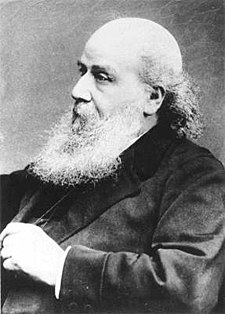
Andrei Andreevich Markov

Andrei Markov lived most of his life in St. Petersburg, Russia. During his lifetime, was the capital of czarist Russia, a major seaport and commercial center, as well as an international center of literature, theater, music, and ballet. Markov's  famili belonged to the upper class; his father worked for the forestry department and managed a private estate.

In high school, Markov showed a talent for mathematics but generally was not a good student. He studied at St. Petersburg University, where he received his bachelors, master's and doctor's degree. He then went on to teach at St. Petersburg University. The head of the mathematics department, P. L. Chebyshev, was a famous mathematician and statistician. Markov become a consistent follower of Cebyshev's ideas. Nominated by Chebyshev, he was elected to the prestigious St. Petersburg Academy of Science.

Thursday, May 19, 2011

James Joseph Sylvester

James Joseph Sylvester was product the theory of matrices through unique partnership with Arthur Cayley. They met in their twenties and were friends, colleagues, and co-authors for the rest of their lives.


Sylvester's mathematical ability had been recognized at an early age. He studied mathematics at the University of London at the age of fourteen, under Augustus De Morgan. He entered Cambridge University at the age of seventeen and won several prizes. However Cambridge would not award him his degrees because he was Jewish. He completed his bachelor's and master's degrees at Trinity College in Dublin. Many years later, Cambridge changed its discriminatory policy and gave Sylvester his degrees.

Arthur Cayley

Arthur Cayley was product the theory of matrices through unique partnership with James Sylvester. They met in their twenties and were friends, colleagues, and co-authors for the rest of their lives.

Cayley's mathematical ability was recognized at an early age and he was encouraged to study the subject. He graduated from Cambridge University at the top of his class. After graduation, Cayley was awarded a three-year fellowship that allowed him to do as he pleased. During this time, he made several trips to Europe, where he spent his time taking walking tours, mountaineering, painting, reading novels, and studying architecture, as well as reading and writing mathematics. He wrote twenty five papers in mathematics, papers that were well received by the mathematical community.

Wednesday, May 18, 2011

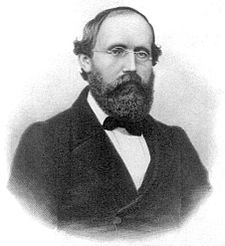
Bernhard Reimann

The ground-breaking work of Lobachevsky and Bolyai was ignored for many years. The mathematician who finally convinced the academic world of the merits of non-Euclidean geometry (that is, geometries based of Euclid's Parallel Postulate) was born in 1826, at the time when Lobachevsky and Bolyai were initially presenting their ideas. Although his life was cut short (he died of tuberculosis at the age of thirty-nine), Georg Friedrich Bernhard Reimann's contribution to the world of modern mathematics was monumental.

At the age of nineteen, Bernhard Riemann enrolled at the University of Gottingen with the intention of pursuing studying of theology and philosophy. However, he became so interested in the study of mathematics that he devoted his life entirely to that field. As a graduate student at the Gottingen, Riemann studied under Gauss, who was unusually impressed with his protege's abilities. In his report to the faculty, Gauss said that Reimann's dissertation come from "a creative, active, truly mathematical mind, and of a gloriously fertile originality." Coming from prince of mathematicians, that was a compliment indeed!

Nikolai Lobachevsky

Labeling it "imaginary geometry," Nikolai Lobachevsky published the first complete text on non-Euclidean geometry in 1829. Many have since heralded him as the Copernicus of geometry. Just as Copernicus had challenged the long-established theory that the earth was the center of the universe, Lobachevsky's alternative view of geometry was in direct contradiction to the long-revered work of Euclid. Referring to Lobachevsky, Einstein said, "He dared to challenged an axiom."

Lobachevsky spent most of his life at the University of Kazan, near Siberia. Founded by Czar Alexander I in 1804, Kazan was Europe's easternmost center of higher education. Among its first student, Lobachevsky received his master's degree in mathematics and physics in 1811 at the age of eighteen. He remained at Kazan teaching courses for civil servant until 1816, when he was promoted to full professorship.

Janos Bolyai

Janos Bolyai was a Hungarian army officer and the son of respected mathematician. From an early age, Janos was exposed to the world of mathematics. Janos's father, Wolfgang, had studied with Gauss at Gottingen, and their sporadic correspondence lasted a lifetime. In fact, in their correspondence, Gauss had pointed out the fallay in the elder Bolyai's 'proof' of the Parallel Postulate.

In 1817, Janos entered the Imperial Engineering Academy in Vienna at the age of fifteen. After completing his studies in 1823, he embarked upon a military career. An expert fencer with numerous successful duels to his credit, Bolyai was also accomplished violinist.

Girolamo Saccheri

In all the furor to prove the Parallel Postulate, one particular attempt is worth mentioning. In 1733, a Jesuit priest names Girolamo Saccheri published Euclides abi Omni Naevo Vindicatus (Euclid Vindicated of Every Blemish). This work contained Saccheri's proof of Parallel Postulate. Saccheri was a professor of mathematics, logic, philosophy at the University of Pavia, Italy. He is said to have had an incredible memory; commonly mentioned was his ability to play three games of chess simultaneously, without looking at chessboard.

Saccheri was the first to examine the consequences of assuming the Parallel Postulate to be false; that is, he attempted a proof by contradiction. Reductio ad absurdum, or proof by contradiction, is an indirect means of proving a statement. Simply put, in order to prove something, you assume it to be false. If you can show that the assumption lead to contradiction, then the assumed falsity of the statement is itself false, implying that the statement is true. This is acceptable line of reasoning that has been used since the days of classic Greek logic. Euclid himself use it in Elements, but not in reference to the Parallel Postulate.

Tuesday, May 17, 2011

Hypatia of Alexandria

Hypatia, one of the first women to be recognized for her mathematical accomplishments, lived in Alexandria, one of the largest and most academically prominent cities on Mediterranean Sea. This Hellenistic city was farmed for its university and its library, said to be the largest of its day.

Hypatia's early environment was filled with intellectual challenge and stimulation. Her father, Theon, was a professor of mathematics and director of the museum  and library at the University of Alexandria. He gave his daughter a classic education in arts, literature, mathematics, science and philosophy. In addition to her studies at the University of Alexandria, Hypatia traveled the Mediterranean. While in Athens, she attended a school conducted by famed writer Plutarch.

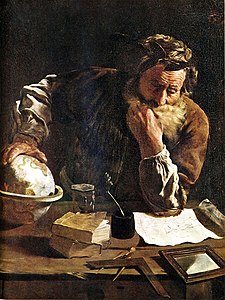
Archimedes of Syracuse

Archimedes demonstrated that a very heavy object could be raised with relatively little effort by using a series  of pulleys (a compound pulley) or by using levers. He was so confident of his principles of levers and pulleys that he boasted he could move anything. One of Archimedes many famous quotes is "Give me a place to stand and i will move the Earth!"

Aware of his genius, King Hieron turned to Archimedes on many occasions. One amusing legend concerns  the problem of the king's gold crown. After giving a goldsmith a quantity of gold for the creation of an elaborate crown, King Hieron suspected the smith of keeping some of gold and replacing it with an equal weight of silver. Since he had no proof, Hieron turned to Archimedes. Pondering the King's problem, Archimedes submerged himself in a full tub of water to bath. As he climbed in, he notice the water overflowing the tub. In a flash of brilliance, later we fame bout flash of genius, he discovered the solution to the king's problem. Overjoyed with his idea, Archimedes is rumored to have run down the street totally naked, shouting "Eureka! eureka!" (i have found it! i have found it!)

Monday, May 16, 2011

Euclid of Alexandria

Euclid - books was consider as the one of most published book on earth.  Element, name of Euclid's book, was hand-copied by scribes for nearly 2000 years. Since the coming of printing press, over 1.000 edition have been printed, the first in 1482. Element consist of 13 books, or units. Although most people associate Euclid with Geometry, Element also contains number theory and elementary algebra, all the mathematics known to the scholars of the day.

Euclid's monumental contribution to the world of mathematics was his method of organization, not his discovery of new theorems. He took all the mathematical knowledge that had been compiled since the days of Thales and organized it in such a way that every result followed logically from its predecessors. To begin this chain of proof, Euclid had to start with a handful of assumption, or a thing that cannot be proved. These assumptions are called axioms, or postulate, are accepted without proof. By carefully choosing five geometric postulates, Euclid proceeded to prove 465 result, many of which were quite complicated and not at all intuitively obvious. The beauty of his work is that so much was proved from so few assumption.

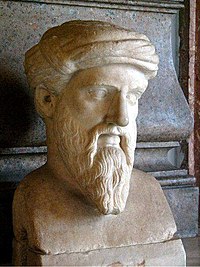
Pythagoras of Samos

The name Pythagoras is synonymous with the famous formula that relates the lengths of the sides of a right triangle. However, the life and teachings of this famous Greek mathematician, philosopher, and mystic are shrouded in mystery, legend, and conjecture.

Born on the Aegean island of Samos about 500 B.C., Pythagoras traveled and studied extensively as a young man. His travel took him to Egypt, Phoenicia, and Babylonia. Returning to Samos when he was fifty, Pythagoras found his homeland under the rule of the tyrant Polycrates. For an unknown reason, Pythagoras was banned from Samos and migrate to Croton, in the south of present day Italy, where he founded a school. His student and disciples, known as Pythagoreans, eventuallycame to hold considerable social power.

Thales of Miletus

The empirical geometry of Egyptians reached the ancient Greek through commerce, travel, and warfare. One of the first Greek scholars to study this geometry was Thales of Miletus. Thales is known as the first of the Seven Sages of Greece.

A successful businessman, statesman, and philosopher, Thales had occasion to travel to Egypt and consequently learned of Egyptian geometry. While in Egypt, he won the respect of the pharaoh by calculating the height of the Great Pyramid of Cheops. He did this by measuring the shadows of the pyramid and of his walking staff. Knowing the height of his staff, he used a proportion to calculate the height of the pyramid.

George H. Gallup

To many people, the name Gallup is synonymous with opinion polls. George Horace Gallup, the founder of the American Institute of Public Opinion, began his news career while attending the University of Iowa. During his junior year as a student of journalism, Gallup became the editor of his College newspaper, the Daily Iowan. After receiving his bachelor's degree in 1923, Gallup remained at the University nine years as an instructor of journalism.

In addition to teaching, Gallup continued his own studies of human nature and public opinion. Interest in how the public reacts to advertisements and perceives various issues of the day led Gallup to combine his study of psychology. In 1925, he received his master's degree in psychology. Gallup's studies culminated in 1928 with his doctoral thesis, A new technique for Objective Method for Measuring Reader Interest in Newspaper. Gallup's new technique of polling the public was to utilize a stratified sample, that is, a sample that closely mirrors the composition of the entire population. Gallup contended that a stratified sample of 1,500 people was sufficient to obtain reliable estimates. For his pioneering work in this new field, Gallup was awarded his Ph. D. in journalism in 1928.

Sunday, May 15, 2011

Carl Friedrich Gauss

Dubbed "the prince of mathematics", Carl Gauss is considered by many to be one of the greatest mathematicians of all time. At the age of three, Gauss is said to have discovered an arithmetic error on his father's bookkeeping. The child prodigy was encouraged by his teacher and excelled throughout his early schooling. When he was fourteen, Gauss was introduced to Ferdinand, the Duke of Brunswick. Impressed with the youth, the duke gave Gauss a yearly stipend and sponsored his education for many years.

In 1795, Gauss Enrolled at Gottingen University, where he remained for three years. While at Gottingen, Gauss had complete academic freedom; he has not required to attend lectures, he had no required conferences with professors or tutors, and he did not take exams. Much of his time was spent studying independently in the library. For reason unknown to us, Gauss left the university in 1798 without diploma. Instead, he sent his disertation to the University of Helmstedt and in 1799 was awarded his degree without the usual oral examination.

Gregor Johann Mendel

Johann Mendel was born to an Austrian peasant family. His interest in botany began on the family farm, where he helped his father graft fruit trees. He studied philosophy, physics, and mathematics at the University Philosophical Institute in Olmutz. He was unsuccessful in finding a job, so he quit the school and returned to the farm. Depressed by the prospect of a bleak future, he became ill and stayed at home for a year.

Mendel later returned to Olmutz. After two years of study, he found the pressure of school and work to be too much, and his health again broke down. On the advice of his father and a professor, he entered the priesthood, even though he did not feel called to serve the church. His name was changed from Johann to Gregor.

Friday, May 13, 2011

Blaise Pascal

Pascal was aptitude for science and math since childhood. Unlucky, pascal had a poor health that make his life suffer almost of his time.

At sixteen, he wrote paper on geometry field. He won the respect of the French mathematical community. At age of nineteen, in order to assist his father, a tax administrator, he invented the first calculating machine. Besides co-founding probability theory with Pierre de Fermat, he contributed to the advance calculus, and his studies in physics culminated with a law on the effects of pressure on fluids that bears his name.

Roger Penrose

Many of us know Roger Penrose as a Scientist on Physics. He considered as a mathematicians that play with time and space. He work on quantum - relativity physics. He also well known on string theory. But Fact, he is a mathematician at Oxford. Based on that He famed as mathematical physicist.

His work on physics well known is Twistor theory. Twistor mapped real life model on Minkowsky space as a 4D complex space. He is intended to work at singularity to build a perfect knowledge at the stability of the univers.

In Mathematics field, he write a thesis "tensor method algebraic geometry". Its led him to the 'art' work of mathematics known as impossible object. Its become famous on impossible triangle and polygon known as his name.

Georg Cantor

Russian born mathematicians who also known as a philosopher was born St. Petersburg. He is Georg Ferdinand Ludwig Philip Cantor. His father was a stockbroker and wanted him to become an engineer. Cantor also have a musician blood from her mothers family line. How expect that he pursuing mathematics career on his life.

Cantor learn engineer from University of Zurich in 1862. But its just for an half year then he decide to surf philosophy and mathematics. He transferred to the prestigious University of Berlin. He were pupil of famed Karl Weierstrass, Ernst Kummer, and Leopold Kronecker. He recieve his doctorate. Later, he accepted teaching position at Halle and remain there until retire in 1913.

Augustus De Morgan

Being born blind in one eye did not stop Augustus De morgan from becoming a well-read philosopher, historian, logician, and mathematician of course. De Morgan was born in Madras, India, when his father was working for East India Company. Moving to England, De Morgan was educated in Cambridge, and at the age of twenty-two he became the first professor of mathematics at the newly opened University of London (later renamed University College).

Demorgan viewed all of mathematics as an abstract study of symbols and of systems of operation applied to these symbols. While studying the ramification of symbolic logic, De Morgan formulated the general properties of complementation that now bear his name. De Morgan aslo wrote on calculus, algebra, and probability.

Thursday, May 5, 2011

Gottfried Wilhelm Leibniz


Besides a role in calculus, German Men, Gottfried Wilhelm Leibniz has a contribution in the development of Symbolic Logic. When small, Leibniz study a range of knowledge in a self-taught. He learned Latin himself when he was eight years old and began studying Greek at the age of twelve. At that time, he was studying the works of Aristotle and became interested in Formal Logic.

At the age of fifteen years, Leibniz became students at the University of Leipzig to study law. He received his bachelor's degree two years later and master the next year and then moved to the University of Nuremberg.